Friday, October 07, 2005

Cheap Meds... no not spam...


A lot is made out of the issue of medicine costing so much in the US. While in Canada, it costs considerably less. Well, let me tell you, overseas, it cost next to nothing.

For this out-door clinic we treated about 1,500 people in less than four days. A lot, by just about any standard. We treated them with medicine purchased from a reputable "in country" provider. Almost 1 ton of pills, no joke! The left overs we left with the local clinic to be disbursed after we left.

Here is the most amazing part though... all of that medicine cost us only $1,800 US. In fact, even with all the travel expenses to get the Dr's over there and purchasing the medicine and supplies, it still cost us less than $5.00 per person to treat them.

Compare that with the last Dr visit I had. $94.00 for 5 minutes time with the Dr. $60 for the medicine, generic, purchased at the local pharmacy. I didn't even have any travel expenses!

I know that there are a lot of differences between the kind of care we gave that day and the kind of care I pay for in the states. Really, though, was it 30 times better?

I'm not much of an activist, but this sort of thing really gets me worked up. For one thing, think of how many people could be helped if we all chipped in to the world health problems. Second, is the care we are getting for so much in the US that much better? Should there be changes?

Ok, so forget about the US for the moment. Think about this... a clinic operating in a place like Midigo, can be fully staffed and operated for as little as $3,000 per month. Bring that number up to about $6,000 and you have a 100 bed hospital with surgical capability. The alternative? 60,000 people with no alternative, but to die.

Medical Care in Midigo


I should probably describe Midigo town a bit better.  It is really more of a trading center than a town.  As I have mentioned before, there is no public services, at all…  There is a elementary school, and a secondary school.  A small health clinic is just at the edge of town.  The center of life is the market.

The health clinic has really improved a lot since I first visited.  When I first saw it, there was no food.  Each patient was responsible for their own food.  There was no medicine.  Getting medicine would require a 30 mile walk to the nearest town.  Even then there was only the most basic of medicine.  There was a single trained health care worker.  What they called a medical officer, something similar to nurse practitioner.

As I mentioned before, the child mortality rate was about 40%.  This little center had about 4-5 deaths per month from just snake bites!  They tried, they really did, but this was at the end of the line.  Midigo was the last stop before the frontier.  The Ugandan government just did not get up there.  Any supplies sent to them would get stopped at several larger towns on the way, and badly needed meds taken for emergencies there.

One of the first items on our list of work there was to get an idea for situation.  We brought a team of two MD’s and two RN’s, plus several lay people.  We set up camp in the secondary school (they were on break) and created an outdoor clinic in front of the medical center.  The local official sent word that we were giving a free clinic and waited to see what would happen.

The next morning we were astounded!  A minimum of 4,000 people were waiting for us to get started.  I drove down the roads and found a constant stream of people walking towards the clinic for miles around.  We had our answer, the problem was overwhelming.

The picture above is just part of the line waiting for medical care. A couple of things to note. First, the people are well dressed. This was a big occasion for the community. A social event as much as a serious medical clinic. So each person wore their "Sunday Best". The second thing to notice is the line of men on one side and women and children on the other.

This was something that would frustrate me to no end. Probably as much as anything drive me to anger. The priorities always went to the strongest. Whoever could push their way to the front wanting to get some free medicine, for really no medical reason. Left behind, and sometimes left to die were the weak who could not force their way front.

To deal with this problem, we would form at least three lines. One for the men, one for the women and small children and one for the school children (the teachers would bring them from class in hopes of getting them some help). I would stand and choose people from each line as I saw fit, trying to take as many of the really sick before the healthy men would start to complain. Then I would take a token man from the line.

Additionally, I would send our nursing staff to quitely walk through the crowds of people. They would greet the women and without drawing too much attention, examine the babies. Many, many times they would find desperately ill children, sometimes hours from death being shoved out of the way. So the nurses would take them one by one around the back of the clinic and bring them in for treatment. A lot of live were saved this way.

Thursday, October 06, 2005

Nile Crocs are big too...


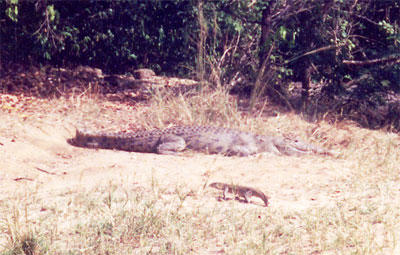
Ok, another really big animal is the Nile crocodile. The one in the picture is about 3 meters long. You can get an idea of it's size from the Monitor lizard in the foreground. The monitor is about 1 meter, give a little for perspective and the croc is about 3 meters or more.

The monitor lizard is there to steal the croc's eggs. The Croc looks quite capable of simply turning it's head and taking care of the egg stealing problem. However, for some reason, I never saw a croc attack a lizard. Although I suspect that if it caught the lizard digging eggs out of it's nest it would be a different matter.

Both of these animals really are incredible though... Both of them must be fully capable of surviving in this environment. Yet both are really tied to the destruction of the other. So maybe that was a little philosophical... But it is just really cool to see them together like this.

Cape Buffalo are Huge!


Cape Buffalo are huge animals. This pair was in the Murchison Falls game park in Uganda. To give you an idea of scale, the grass the are standing in is about 4 or 5 feet high!

Some people say they are the most dangerous animals in Africa. I think I just might agree. On at least one occasion we had these animals surround our SUV, and charge!

They are very defensive of their young. So a classic herd maneuver would be to surround the young in an outward facing circle. Then the males will attempt to drive off the attacker. In one case this was my wife! She was driving down the road and stopped to admire the herd of buffalo, only to see them begin to encircle her truck.

She says that is when she learned to drive fast in Africa.

Pleading


After my night of malaria and after my time pounding Cassava with the women, it was time to start work.  The elders had been meeting all night to talk about me and what was to be done.  They had a lot of things to work out.  There was a possibility of me bringing in quite a bit of development, resources and most of all money.  

They needed to find out who was going to get the construction contracts (they were thinking big).  Which areas would get the development first, what projects would get done.  Many things to decide.  When they were ready, I was invited into a hut and sat in a circle with them.

Once in the circle, I found myself being presented in turn with each request.  It was a very formal meeting, and one which was spoken in respect for each other.   Ugandan’s, rarely if ever raise their voices.  In fact, except for celebrations, I don’t remember a single raised voice.

While this was going on, a man approached the door.  He was holding a baby.

The men in the hut shooed him away, but he kept coming back.  I could tell from the glances at me that he wanted to tell me something, but the elders did not want him to bother me.  Finally, after watching him for almost 30 minutes, I asked my translator what it was that he wanted.

He wanted me to take the baby.  The mother had died shortly after birth.  With no formula, or medical care available, the baby was slowly dying of malnutrition.  The father had been trying to feed it anything he could find, but there was nothing to supplement a mother’s milk.

Now the baby was nearly 10 months and still weighed about 10 lbs.  I could see in the father’s eyes, the pleading look.  He could not speak English, and I could not speak Aringa, but we didn’t need words.  I knew that I couldn’t help.  We had a job to do, and if I was going to be effective in that job, some things I had to let go…

Sitting here, now, I wish I had done things differently.  I wish I had helped, taken the baby home to Nicole.  Anything would have been better than remembering the father’s eyes, his pleading…

Wednesday, October 05, 2005

The white snake that spits fire...

One of the stranger encounters was with the "white snake that spits fire". This is such a strange episode in my work, I'm not even sure how to categorize it. I pretty sure that it was a very spiritual matter for the Aringa, (people living in Midigo). For me that did not even occur to me until well into this story.

I was visiting a place called Choro a few miles from Midigo. We had planned to build our base here, and I was looking over the land for the right spot.

There are two small hills, really basalt outcrops, one on each side of the trail/road. If fact that is where the name comes from. Choro means "two hills" in Aringa. Well one was taller than the other and I decided I would climb it to get a better vantage point.

As I approached the hill, several men stepped in front of me. They told me, through the translator, that I could not go there. I was puzzeled. I had never been stopped from going any place before... so I asked why? The men told me that there was a large snake on the hill and it would harm me.

Hmmm... a large snake that would harm me... Most people I suppose would take that as a good answer and walk away. I got extremely curious though. A large snake in that part of the world could be a Mamba, or a Gobon Viper, or even a Cobra. All dangerous, but all rare sights. So I got excited, I started walking toward the hill again and told them I wanted to see the snake. They again stepped in front of me and stopped me.

This time they meant business. They told me that this snake was the "white snake that spit fire". Wow! Now I was really, really excited. All I could think of was that this was some kind of Albino snake, with a biolumonesence. I had never heard of any reptile that used biolumonecense. This could be the discovery of a life time.

Since they were not going to let me go near it that day, I thought I would find out all about it. I started asking questions.

"What is it?" - "The white snake that spit fire"
"I mean kind of snake is it?" - "A white snake"
"Why does it spit fire? " - "So that it can trap its prey"
"What does it eat?" - "Insects"
"Who has actually seen this snake?" - "No one"

uh oh, now I realize something is up. Still there must be some kind of truth to this story. For several weeks, any time I saw someone new, or one of the elders I would ask them about this snake. For the most part I found this to be a "boogie man" story.

The elders told me that their parents told them about it. They said at night they could see the lights up on the mountain (Midigo Mountain). When they saw the lights, they knew it was hunting. It seemed to live wherever there was trouble, a kind of omen. When the snake left the area, it was known that things were ok again.

Later as I traveled more in the region they told me about how the snake had been living on the hill nearby, but the snake had left just before I arrived. In fact they told me it had been near town, when I had first arrived.

More to the science of it. I discovered that there was a kind of lightning bug, that lived in the region. It was quite rare, but I did see it on several dark nights. I believe that this whole thing is a mixture of myth and a little bit of nature. They would see the bugs glowing, and believe the snake had spit them out. There was usually something going wrong at the time and it could be blamed on snake.

I wish I had more time to spend learning from them. This is one of those stories that I'm sure will be lost soon enough.

They did it!


A few years after I had left Uganda, I got the chance to return to Midigo for a few days.  The trip was much more emotional than I had ever imagined.  I remember visiting our house in Arua and break down into sobs.  There was so much of my families life tied up in a relatively short period of time in Uganda.

Well, back to Midigo… I was there with some of my good friends, one of them Rob Frear, was walking through town with me.  We began to hear a very odd, but familiar sound.

It was a diesel engine, running in the distance.  It was familiar to us, but completely out of place in Midigo.  No vehicles ever went to Midigo.  There are no sounds of civilization there only natural sounds.  Yet, we were sure we were hearing a engine.

The two of us walked through the village towards the sound of the engine.  By now you have probably put it together that it was the maze mill.  At the time though, that maze mill was completely forgotten by me.  We finally found the small shed were the sounds were coming from, and stopped about 50 feet from it, wondering what it was.

“Yi-EEEEE” came bursting from the trees near by.  Three of the original women, who were with me that night of Malaria and the next day pounding Cassava and finally when we delivered the maze mill years before, came running to me.  

It was really only when they showed me the mill that it all became clear.  They not only had kept the mill going, but hired an operator to run it.  Hired watchmen to guard it at night.  Built a nice shed with a concrete floor.  Even more astounding they told me how they had saved up enough money to purchase a second maze mill.  They were planning to install the second one in a nearby town.

You can not believe the joy!  This was the first real evidence that my family and I had made a difference, a lasting difference.  It turned out that there was even more that ha happened while I was gone, I’ll have to get to that on another post.

Tuesday, October 04, 2005

Maze Mill for the Women

One of the very first things I did as an emergency aid worker in Uganda, that was NOT emergency or aid, but rather community development.   I wanted to get a maze mill for Midigo. It took some work, I convinced my superiors that it was actually part of a plan to build an air base closer to Sudan.

However, it ended up, some of my proudest momements are surrounding this maze mill and that group of women who took care of me while I had malaria. If I had not gotten malaria that night, and they had not taken care of me that night, I would not have taken the time to learn something about the local women...

I do remember the day we delievered the mill very well. We had driven all day from Kampalla to Midigo. About 14 hours, mostly over the worst roads you can imagine. The roads were so bad that the door on one of our SUV was bent on it's frame by the time we arrived.

Driving into Midigo is such a happy time for me. It always starts about 5 miles outside town. The children know me by now. They are so excited to see us. They all hear our trucks and run our of their houses, with huge smiles on their faces, waving and yelling! This progression continues all the way to town. Where, by now everyone has gathered to see what the fuss is about.

We made sure the "womens group" as they call themselve, and each town has one, was brought to the front. We opened the door to the SUV and "Yi EEEEEEE!!!!" The women yelled this for a good 15 minutes or so as we unloaded it. Needless to say they were happy.

The maze mill was really just a good sized deisel engine, which had a series of PTO connections. The one we purchased had a grinding mill for one PTO and a small generator on another. We gave them two 5 gallon containers of deisel and hired a mechanic to set it up for them. However, there would be no additional support from us. We really wanted these people to take ownership of it.

Typically, these sort of things would not work out. Usually they would run for awhile, but no money would be saved and the first time it broke down, that would be the end of it. But I really want to give them the practice of putting this together. Perhaps the next time they would be able to take it further.

Monday, October 03, 2005

Getting past Malaria...

Well, I didn't even try the goat.  I just couldn't, it both looked and smelled nasty.  I know I hurt the feelings of the women who brought it, but I tried to make up for it later.

The next few hours I went into and out of sleep. My fever broke about dawn that next morning.  I walked out of the hut the next morning to a peaceful village in Africa.  The men had moved to another hut to let me sleep.  The soldiers were mostly gone, with the danger being a rebel attack during the night also gone.

Children were playing, not near me, I think they were scared.  They played just at the edge of the clearing.  Smoke from cooking fires mixed with a pleasant morning breeze.  It was a good morning.

Not too far from my hut were the same women who had helped so much the previous night.  They were laughing and catching up on gossip, while pounding cassava.    

I know this is a really rookie mistake, but I blame it on the post malaria weakness.  I decided to teach the women something about nutrition.  You see during my limited training back in the states I had found out that Cassava was nutritionally very poor.  It is a large “tuber” that takes about two to three years to mature.  Each one of the massive roots is about 4 inches in diameter and a foot or more long.  Think of them as huge potatoes.

These are pealed, boiled and dried.  Cut up into chunks, and spread out on a blanket or tarp, if the have some.  Once dried it formed a loose chalky white chunk or pulp.  This is then mashed in a large mortar and pistil.  

Well, that is exactly what the women were doing when I walked up to them.  One of them spoke some English, so she translated for me.  I asked why they were spending so much time on Cassava when maze was much more nutritious?    

They laughed and asked me if I have ever pounded Cassava?  Well of course I never had, I am from America were everything is done for us.  So they handed me the wood post that they had been using to pound the cassava.  It took me about 30 seconds to realize this was hard work.  They then pointed out how much softer cassava was than maze.

I discovered something important that morning.  I could never assume I knew anything about them or why they do the things that they do.  They were pounding cassava because there was no mill for many days walk in any direction.  They grew the cassava instead of maze because they had no way to grind the maze. 

I didn’t tell them then but I decided one of my first priorities was to get them a maze mill.

My first night in Midigo...

My first night in Midigo didn't really go like I thought it would. That afternoon I had my first run in with Malaria. Unfortunately it was just before a speech by the deputy Prime Minister a Mr Ali. I made it through my short speech and promptly passed out in the back seat of our Land Rover.

Pretty much the next thing I remember was arriving at night in Midigo. I would describe it as completely dark. Not a single light for perhaps a hundred miles. It was really dark. We had picked up our escort by that time. A platoon of Ugandan Army soldiers. I remember making a Sat-phone call to my wife in Nairobi. She was worried of course. I described my fever and body aches and mild delerium. I was a long way from any help.

She called the Emergency Operations Center for our group back in the US and they talked with a tropical medicine specialist, who thought it could be malaria. So they sent a page out to me, by Sat-pager, telling me what I had and how to treat it. Then 10 minutes later they sent a second message reminding me where in my medical kit the meds where and that I really needed to take it.

Wow, image that... More amazing was that the women of the village already knew all of this. They were quite concerned. I remember them bringing me some tea. We were in a round hut, and each woman entered the room on their knees and head down... Through the fever and the poor lighting coming from a single flashlight pointed against the wall, I could see these women coming towards me and I had no idea what to do.

My interpeter told me to hold my hand out to them. Ok, now I'm wondering if I'm getting married, (I'm not kidding they offered me a second wife earlier in the day). All of what I had been taught in western society, said that I was to treat women the same as men, yet here they where, on their hands and knees, before me. This can't be right? Not knowing anything else to do, I put my hand out...

They took my hand and pressed it to their foreheads. Then looked up at me an smiled, before backing out of the room on their knees. After that they seemed able to interact with me without much more fanfare.

These women, I later learned were selected to "take care of me". Thankfully, that did not include the entire African treatment of sleeping with me as well. They did show a lot of concern for me though. Brought me boiled water to take the anti-malaria's. Told me to rest and that I should eat when I woke up.

I didn't know that I would wake up so soon. I found out later that malaria can be very fast onset and very fast to receed once treated. I woke up at about 2:00am. The elders of the village were still in the ajoining room talking about me and what they should do with me. As soon as the women realized that I was awake, they insisted that I eat. While I felt a lot better, I was still very weak, unable to stand.

In a jesture that I thought was one of the most incredible acts I witnessed over there, they slaughtered a goat that night. The village was not doing well and that goat would have been saved for the most important of occasions, but they wanted to treat me right. After boiling the meat they brought it to me on a large plate. The very best parts... the stomach and intestines...

Friday, September 30, 2005

Getting things done in Midigo

As I described in the last post. The women are the people who really get things done. I often found that there was a very important protocol to follow when getting thing done.

Each, time I came to visit, I would be expected to talk with the Elders. Talking would sometimes be a bit of an overstatement. Many times we would sit for hours not saying a thing. That was ok, it was part of the relationship.

At these meetings, with the elders, they would present their needs, or ideas for improving their community. I would listen and talk with them about how that would be a benifit or not for them. Once we all agreed to a project, we needed to find someone to run it.

This is where the women came in. The women were the ones who are responsible for taking care of their families. The men are often detached and drunk. So, the most successful project we helped start all involved the local women as the leaders.

The people living in Midigo

I think one of the best parts of living in Uganda, was the chance to know the people living in Midigo. So, let me share a little about them.

Midigo is in the Yumbe district of Uganda. This is the northwestern corner of the contry and boarders both Sudan, to the north, and Congo, to the west. It is a very hot and mostly arid place.

The people who live there are called the Aringa. Up until very recently, almost no one knew of them. Their language was un-written and untranslated. Very little contact with the outside world. While only about 40 or 50 miles from a medium sized town, Arua, it would take 4-5 hours of hard driving to get to them.

The Aringa, for the most part, have had it very rough. They have been "run-over" by just about every rebel group to ever exist in that region. More importantly, since these rebel groups have been operating in the region, almost no aid ever reaches them. The UN have labeled it a level 3 security zone. Which is to say, there should not be any unnessary personell staying there.

No power, no communication, but still a vibrant communication within their own people. It amazed me how fast village to village communication was, often faster than I could drive between them.

The social structure of the Aringa seems to center on a group of "elders" who are political and social leaders. There is additionally a smaller group of shamen who were described by the translator as "land lords". They would be responsible for the rains, the allocation of land, and keeping the spirits happy. Finally, the women of the Aringa are really the people who get things done.

Thursday, September 29, 2005

Sudan, war and peace...

When my wife and I first looked decided to go to Africa, it was because of the war induced famine in South Sudan. We thought that it was simply not right for people to die because they have no food, when some much of the world has plenty.

Then over the last few years, with a lot of effort, peace came to South Sudan. Even more astonding was seeing John Garang being sworn in as vice-president of Sudan. I never in a million years would have thought that he would ever be given such a position.

Then he died in a plane crash in Northern Uganda. Just a few weeks after he was sworn in... One of the most disheartening days that I have known in a long time.

Finally, we hear today of an attach on a refugee camp in the Dafur region. 29 people were killed when "Arab" militia attacked the camp. Sometimes it just never seems to end.

Sudan: At least 29 killed in Arab militia attack on Darfur camp - UNHCR

This is a mode of operation that has continued for decades in Sudan. The northern government, either by direct instigation, or by simply allowing it to occur, has been doing this since the war began. If they are serious about the peace process, this sort of thing needs to stop.

Wednesday, September 28, 2005

Well baby checks...


Since we got started on the subject of children. This picture is from a well baby clinic that we set up in Midigo. It turns out that this was really important to the people in Uganda.

One of the most racist statements I hear about working over there... "They have been living like this for centurys, why worry about them now?" Or something like that...

It is true, they have been living and dying in Midigo for many many centuries, probably much longer. However, there are two things people need to remember. One, and the most important, is that no one, wants to see loved ones die. Two, despite having few visitors come to visit them, they have been negatively influenced by western cultures.

There are many, many complex issues involved in development work. Just keep thinking, and reminding yourself, that they deserve exactly the same or better treatment than you. Would you want a child to die of malaria, here in the US? How about your home town, or on your street? No, of course not! Why then do people think it is some how ok if it happens in Africa?

About the red chilies in Midigo

Last time I mentioned explaining the red chilies. Well the story starts with money.

The average, family income per year is about $30. Not much, even for a rual area like this. Things like soap, clothes, medicine, school, these all take money. Each item has an impact much deeper than one might think. Take the medicine for instance.

Child mortality in Midigo was at about 40% when I first visited the area. That means that 40% of the children born in Midigo, died before they were 5 years old. Take a moment to think about that... Think about the number of children you know. Now imagine 4 out of 10 not being there.

Now lets take it back to the red chilies...

Nearly all of those children died from malaria. Well not entirely from malaria. Each child was probably also malnourished, suffering from internal parasites and any number of other ailments. However, it was usually the malaria that would push them over the edge.

Malaria medicine, for a child, would cost between 10 and 30 cents. Nothing to us, but to them it is a sizable amount. Now, the family has to decide if they should spend this money on medicine and maybe have the child get malaria again in a month or two. Or, see if the child can pull through on their own.

Well that $30/year doesn't go far with those kind of decisions. So we looked into a way to help them make some extra money. Red chilies are one of the best cash crops in the world. Nearly everyone uses them in cooking. They are light weight and store easily. There is a ready market for them in Uganda and for export. So, with some help from some friends working with USAID we started an agriculture program in Midigo.

Last I heard about 20 families were doing quite well with them. That along with several other programs we worked on made a huge difference in Midigo. During my last trip to Midigo, an elder told me that their "children were not dying anymore."

My goofy mustache


Well, maybe it time to show what I looked like while I was over there. I grew the mustache because, well I thought it made me look more "rugged". Looking at myself now, well it just looks goofy.

Anyway, I am at a place called Midigo. It is in the Yumbe district of Uganda. Just about 20 miles or so from Sudan. Midigo has a long history, but few people know much about it.

When I went to vist it for the first time, in 1999, I was told I was the first white person they had seen in 70 years! Thankfully, that last experience was a good one and a few old "mosea" or elders remembered that person as a good man who help bring medicine during a desease outbreak.

I was there, on the trip in the picture, to deliver some red chillis. (the trouble with that last statement is the amount of exlaining it requires) I'll talk about that in the next post. Actually, there is so much to tell about the people of Midigo. They more than anything I ever did anywhere in Africa, impacted my life.

I think they would be happy to know that they are being remembered. As one elder told me, "he knows how far it is to America" and it is a "miracle that I have come that far". A huge statement for me to absorb, one that I am only now realizing the full meaning.

Monday, September 26, 2005

Delivery room...


Our second child was born in Africa. As she is quick to point out, she my "Africa Girl". We actually had a pretty good experience with the delivery. She was born at a place called Kijabe, Kenya. A large mission hospital, with a very good staff. I doubt we could have a better team of specialist back in the states. That experience is in contrast to most births in Africa.

The photo shows a Sudanese Doctor and the delivery room at his bush hospital. He has had to rig things up with what he has. The Red Cross had given him a small generator, so he has the lights for deliveries at night. Most Sudanese women delivery their babies at home. A close relative or neighbor usually helps out. Only severe complications come into the hospital and most end up not making it at all.

The price some pay...


Since this is my Blog, I figure I get to talk about the things that are important to me. I was thinking, last night, about some of the people I know in Africa. Wondering where they were, how they were doing that sort of thing. I was remembering how much each person, working in relief, wanted to the best we could.

A lot of people critize one organization or another... that includes me... But when you really get to know the people on the ground, working in some of these areas you realize somthing. You realize that each one, no matter how bad of a job YOU think they are doing, each one has sacrificed something big to be there.

My first trip "in country" started back in the US. It was at the Baltimore airport. I was dropping my wife and daughter off at one terminal (for a trip to Grandma's house) and then I was going on to the International Terminal. I remember it so well because it was there that I first believed that I was dead.

I had been told that there was a better then average chance that I would not be coming back from the location I was going. Civil war in Sudan was in full swing at the time and it was danger in the extreme. My wife and I knew this, but felt that it was still something we had to do.

So, there I was kissing my wife goodbye and hugging by daughter, and I realized this may be the last time I see them or touch them. I resigned myself at that point that if I was going to get through this I needed to put my life aside and get to work. My wife told me that she had said goodbye for good that day.

All of this came back to me, very suddenly, about a week later. I was flying copilot in a Cessna Caravan talking off from Loki. Just as we clear the threshold we heard a call come in from another pilot. He was flying a LET 410, ex-Soviet plane. The pilot was a Texan though, rumour had it that he was ex-Air America... how is that for irony. Anyway, the call came in that he had lost his nose gear on take off and was coming for a crash landing.

I remember desperately searching the sky for him. He reported that he had 9 people on board. He asked for the firetrucks to wait for him at the end of the runway. Then he asked for them to pull him out first... his attempt at humor. We were the last flight out as he was coming in and we just could not see him inbound. I thought about where I was going and for just a moment I thought about my family back home.

I wanted to turn around and go back. I could have too... I was in charge of this flight and I could have aborted... but I just thought about all the people back home I would disappoint. They were counting on me to get these supplies to people who needed them. They were counting on me.

Strange, for the first time as I write this I'm realizing I was not flying into danger for the people who needed it (the Sudanese) or even myself, I was doing it for the people back home. I was doing this for all the wrong reasons.

At the time there was a price on the head of any aid worker trying to bring help to the South Sudan. We flew in without a flight plan, under the radar so-to-speak. We used coded transmissions to confirm our location with HQ. But every thing went ok on that trip. We delivered what we needed to deliver. We came home in one piece and I went on to do it many more times. Sometimes even more dangerous missions. But... I don't think I did any of them for the Sudanese or for myself... I did them all for the people back home who wouldn't go.

Saturday, September 24, 2005

What about the roads?


I wanted the title to include something with deep meaning for me. For me the roads in Africa tell the story better than anything. In Uganda, Kenya and Sudan when you travel the roads, you can tell just about everything you need to know about that place.

For one thing, all of the roads are really in very bad shape. In fact some of the very best roads I encountered in Africa were worse than anything in America. But it is not just the quality of the roads that is tell, but also what you find on and around them that are important.

In the Yumbe district of Uganda (the northwest corner), you find very few houses close to the road. Really you would think that almost no one lived there, except if you looked close. When you slow your SUV down and start watching the edges you will see paths. Each path lead to a group of house and branches out from there. I have personally walked for miles down these paths meeting all sorts of people along the way.

I have found that people tend to define their places by the speed of transport. Think about this for a minute. In Africa it seemed that every couple of minutes driving down the road, my driver would say we had just passed this place or that place. Coming from the western US, where you can drive for over an hour before coming to a new place, these Africa places always seemed to close together. It was only when I realized that I was the only motorized vehicle around, that everything made sense. It took them up to an hour to get between those places that I could drive in a few minutes. They were spacing places out in time, the same way we do in the US.

Dispite all the differences, I always came back to the realization that we were all the same.

Friday, September 23, 2005

Loki... on the edge at night...

Loki, Kenya, could have been the desert town from Star Wars. Loki, was the last town before the Sudanese border. Originally a very small place it became the center of the UN's relief program to south Sudan. At it's hight, one flight took off or landed from is dirt runway ever 2 minutes!

The northern extreme of Kenya is home of the Turkana people. One of the pastoralist of sub-sahara Africa. They have mostly been left alone through history. The live in a place where the destert sun is so un-relenting that at time vehicles can not pass. Not too far from Loki is Lake Turkana, where Leaky made his famous discovery decades ago. It is also home to 200lbs Nile perch and a huge population of Nile Crocs.

Now suddenly, the Turkana have people driving through their land, and one of the largest relief operations in the history of the UN taking off from right in the heart of their territory. So it is no real supprise to me that many of them had taken to ambushing the convoys of trucks driving food and medicine to the airbase at Loki.

I remember my first night spent in Loki. I was with a small survey team and we said a place called "Kate Camp". It was called that because a woman named Kate ran it... imagine that. It was really just a bunch of tents set up inside a chainlink fence. There was a kitchen where they served up some pretty good food. Anyway, my first night was spent at Kate Camp, not sleeping.

I wasn't sleeping because every few minutes or so gun shots could be heard. Sometime in the distance sometimes very close. I learned later that "thugs" would try to enter the town and take whatever was not guarded. These shots were the guards taking "pot-shots" at them. I remember laying there just waiting for a stray bullet to hit me... it never did.

For the first time in my life I knew it was morning by the call to prayers coming from the local mosque. I was so relieved...